

How to Choose the Right Size of Mobility Wheelchair
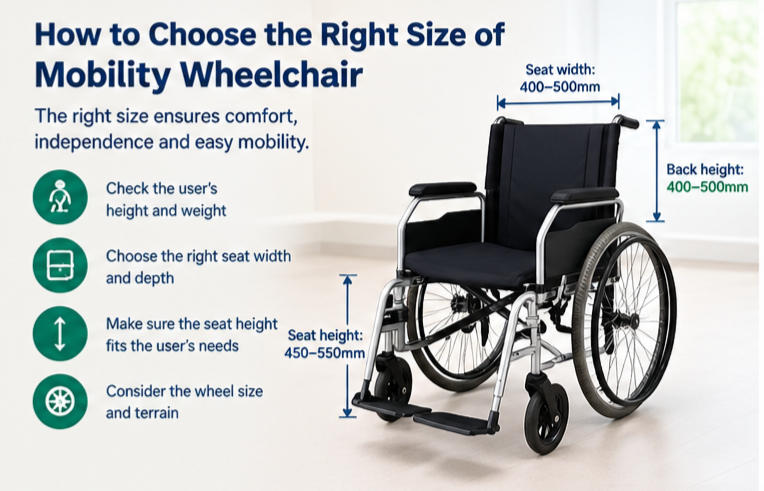
Choosing the right size of a mobility wheelchair can make a major difference in comfort, maneuverability and everyday use. A wheelchair that is too narrow can feel uncomfortable, while one that is too wide may make it difficult to move through doors and narrow spaces.
For distributors, rehabilitation centers, elderly care facilities and healthcare projects, wheelchair dimensions should be matched to both the user and the intended environment.
1. Measure the User First
The first step is to consider the user's body size.
Important measurements include:
Hip width
Sitting height
Leg length
Lower-leg length
User height
User weight
The wheelchair should provide sufficient seating space without being unnecessarily wide.
2. Choose the Correct Seat Width
Seat width is one of the most important wheelchair dimensions.
A typical wheelchair may have a seat width of approximately 400–500 mm, but the appropriate size depends on the user.
A seat that is too narrow can reduce comfort. A seat that is too wide may make positioning and maneuverability more difficult.
For large projects, suppliers should provide different seat-width options when serving users with different body sizes.
3. Consider Seat Depth
Seat depth affects sitting comfort and posture.
The seat should provide adequate support while allowing the user's legs to rest comfortably.
Incorrect seat depth can create pressure or reduce sitting stability, so it should be checked before selecting the final wheelchair model.
4. Check Seat Height
Seat height affects transfers and foot positioning.
Consider how the wheelchair will be used:
Indoor mobility
Outdoor mobility
Hospital use
Nursing home use
Rehabilitation
Bathroom transfer
Daily transportation
The correct seat height should support the user's needs and the surrounding environment.
5. Check Overall Wheelchair Width
Overall wheelchair width is especially important for buildings.
Before purchasing, measure:
Doorways
Elevators
Corridors
Bathroom entrances
Vehicle access
Storage areas
A wheelchair may have a suitable seat width but still be too wide for a particular doorway.
6. Consider Wheel Size and Terrain
Wheel size should match the intended environment.
For indoor applications, maneuverability and compact dimensions may be more important.
For outdoor applications, buyers may need to consider larger wheels, ground clearance and terrain conditions.
7. Check Weight Capacity
Wheelchair sizing also includes load capacity.
Always compare the user's weight with the manufacturer's specified maximum load.
For distributors and engineering companies, providing several load-capacity options can make it easier to meet different project requirements.
8. Consider Folding and Transportation
If the wheelchair needs to be transported frequently, folded dimensions and product weight become important.
Check the:
Folded width
Folded height
Folded length
Product weight
Wheel removal options
Storage requirements
Mobility Wheelchair Size Checklist
Before purchasing, confirm:
User hip width
Seat width
Seat depth
Seat height
Backrest height
Overall wheelchair width
Wheel size
Maximum load capacity
Folded dimensions
Indoor or outdoor application
Choose a Wheelchair Supplier for Your Project
The right mobility wheelchair size should be selected according to the user, environment and intended application rather than simply choosing the largest or smallest available model.
For distributors, rehabilitation companies, nursing homes and healthcare projects, a supplier with multiple size options and OEM customization can provide greater flexibility.
Looking for mobility wheelchairs for distribution or a healthcare project? Share the user's requirements and application environment with your supplier to identify the appropriate specification.