

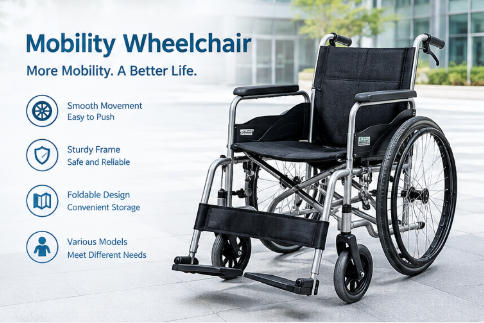
 Mobility Wheelchair: Advantages, Limitations and How to Choose the Right Model
A mobility wheelchair can provide essential support for people who have difficulty walking long distances or maintaining independent mobility.
From hospitals and rehabilitation centers to elderly care facilities and home-care environments, wheelchairs are available in many different designs. The best choice depends on where and how the wheelchair will be used.
Key Advantages of a Mobility Wheelchair
1. Improved Mobility
The most important benefit is helping users move between different locations when walking is difficult or tiring.
A suitable wheelchair can support mobility at:
Home
Hospitals
Rehabilitation centers
Nursing homes
Elderly care facilities
Airports
Shopping centers
Public facilities
2. Reduced Physical Strain
For users with limited endurance, a wheelchair can reduce the physical effort required to travel longer distances.
3. Different Configurations
Manufacturers can offer different wheelchair designs, including:
Manual wheelchairs
Lightweight wheelchairs
Folding wheelchairs
Transit wheelchairs
Reclining wheelchairs
Electric wheelchairs
Different configurations allow distributors and healthcare providers to select products for different market segments.
What Are the Limitations?
A wheelchair can improve mobility, but it does not automatically provide complete independence.
Manual wheelchairs require the user or a caregiver to provide propulsion. Electric wheelchairs can offer greater independence but generally have higher costs, greater weight and more complicated transportation requirements.
Storage, transportation and maintenance should also be considered before purchase.
Manual vs. Electric Wheelchair
| Feature | Manual Wheelchair | Electric Wheelchair |
|---|---|---|
| Price | Generally lower | Generally higher |
| Propulsion | User/caregiver | Electric motor |
| Weight | Usually lighter | Usually heavier |
| Transportation | Easier | More difficult |
| Independence | Depends on user ability | Higher for suitable users |
| Maintenance | Relatively simple | More complex |
| Best for | Basic mobility | Extended independent mobility |
How to Choose the Right Mobility Wheelchair
Important specifications include:
Maximum user weight
Seat width
Seat height
Overall wheelchair width
Wheel size
Frame material
Folding mechanism
Footrest design
Armrest design
Braking system
Cushion requirements
Indoor/outdoor application
For electric models, buyers should additionally consider battery type, driving range, motor performance, charging requirements and transportation regulations.
A Better Choice for B2B Buyers
For distributors and rehabilitation product suppliers, choosing a manufacturer is just as important as choosing the wheelchair itself.
A reliable manufacturer should provide:
Stable production capacity
Consistent quality
OEM/ODM support
Private-label packaging
Spare parts
Technical documentation
Competitive factory pricing
Export experience
A mobility wheelchair should ultimately be selected according to user needs, application environment and required mobility level, rather than simply choosing the lowest-priced model.
For distributors and professional healthcare suppliers, a complete wheelchair product line can also create opportunities across home care, rehabilitation and elderly-care markets.